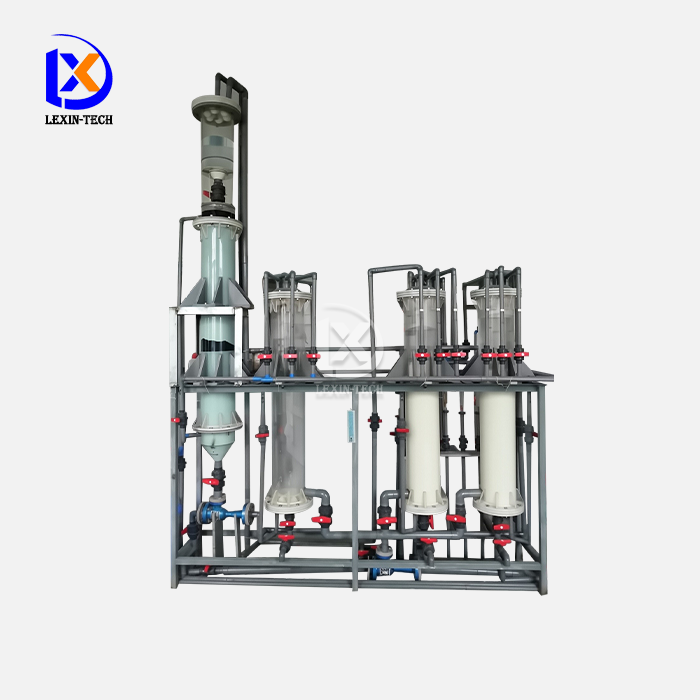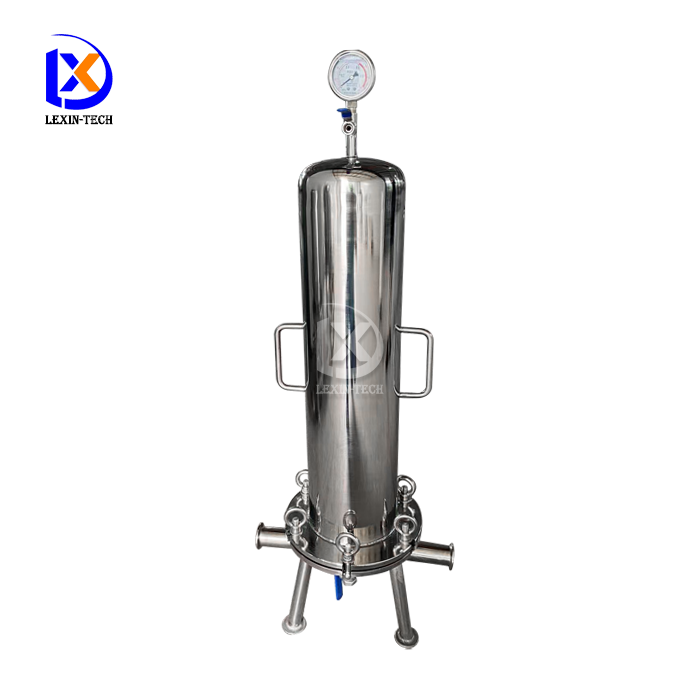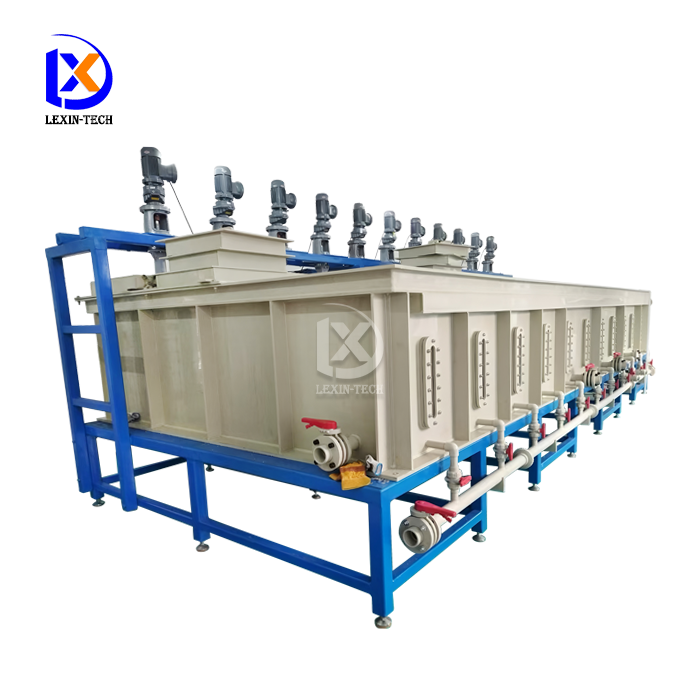

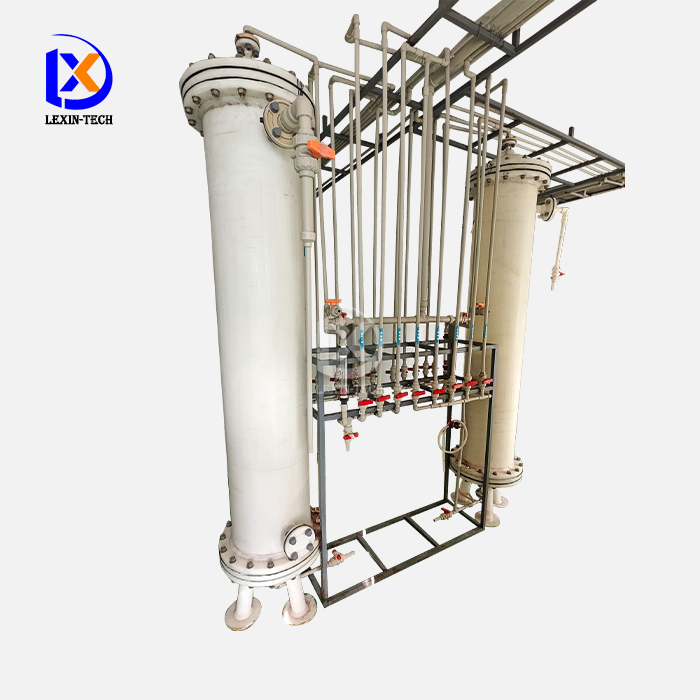
PP Ion Exchange Unit


Exchange Column Material: Polypropylene (PP)
Exchange Column Diameter (mm): 100, 150, 200, 300, 350, 400, 500, 600
Type of Infusion Pump: Metering Pump / Gear Pump
Type of Flowmeter: Electromagnetic Flowmeter / Turbine or Vortex Flowmeter / Float Flowmeter
Equipment Frame Material: Carbon steel with anti-corrosion coating / SUS 304
Control System: One-to-one control via buttons or knobs / Integrated Touchscreen Control
Notes: According to actual customer requirements, customized skid-mounted packages are available. The package primarily consists of an ion exchange system, equipment frame, liquid infusion and flow metering system, control system, storage tanks, and other components.
- Product Description
High-Performance PP Ion Exchange Unit for Chemical Processing
Deep separation and purification of solutions is a critical step in ensuring product quality, enabling resource recovery, and meeting environmental standards. As an efficient separation and purification method, ion exchange technology is widely applied in scenarios such as the removal of trace impurities, enrichment of target ions, and deep purification of water quality, leveraging its advantages of strong selectivity, high separation precision, and reusability. With its unique characteristics—excellent corrosion resistance, lightweight design, high-temperature tolerance, cost-effectiveness, and good processability—— Our PP Ion Exchange Unit effectively addresses the shortcomings of traditional metal, ceramic, and ordinary plastic material units. It has become a core component in separation and purification systems as well as in applications involving harsh media, driving the industrialization, energy efficiency, and sustainable development of advanced solution separation and purification technologies.

What Makes Our Ion Exchange System Special?
Prevalent Chemical Resistance:
Your operations ask reliable adapt that won't drop level underneath pitiless conditions. Our polypropylene material passes on remarkable resistance to most acids, dissolvable bases, and salt courses of action. You'll never stretch around chloride extend disintegration part that plagues stainless steel systems.
Exceptional Ethicalness Standards:
When metallic debasement is zero-tolerance, you require equipment that won't channel contaminants into your handle streams. The smooth, non-reactive surface expects scaling and contamination adsorption. This makes it an ideal choice for high-purity material preparation processes.
Cost-Effective Performance:
Why spend expect wholes on shocking combinations when you can finish transcendent comes around at a division of the gotten? Our thing gives astounding regard while passing on industrial-grade execution for temperatures up to 90°C.
Technical Specifications
| Parameter | Options |
|---|---|
| Exchange Column Material | Polypropylene (PP) |
| Column Diameter (mm) | 100, 150, 200, 300, 350, 400, 500, 600 |
| Infusion Pump Type | Metering Pump / Gear Pump |
| Flowmeter Type | Electromagnetic Flowmeter / Turbine or Vortex Flowmeter / Float Flowmeter |
| Equipment Frame Material | Carbon steel with anti-corrosion coating / SUS 304 |
| Control System | Button/knob control / Integrated touchscreen |
| Customization | According to actual customer requirements, customized skid-mounted packages are available. The package primarily consists of an ion exchange system, equipment frame, liquid infusion and flow metering system, control system, storage tanks, and other components. |
Key Features That Deliver Results
Tall Selectivity Performance:
Our framework exceeds expectations at isolating low-concentration particles in blended arrangements. Cation-exchange gums viably expel cations whereas anion-exchange tars target anions particularly. This exactness makes a difference you accomplish the immaculateness levels your handle demands.
Simple Operation with Regenerable Resins:
You'll appreciate the direct operation cycle. The tars recover effectively, lessening operational costs and downtime. Your group can keep up reliable execution without complex procedures.
Robust Construction:
The adjusted mechanical quality and sturdiness of polypropylene guarantees long-term unwavering quality. Not at all like PMMA choices, our units withstand higher working weights and liquid impacts successfully.
Industrial Applications
Hydrometallurgical Processing:
Your metal recovery operations benefit significantly from our PP Ion Exchange Unit. The system excels in precious metal recovery from acidic leachates. You can process gold, platinum, and palladium without vessel corrosion contaminating your valuable concentrates.
Water Treatment Field:
In the field of water treatment, PP ion exchange units are primarily used for deep purification of drinking water, industrial wastewater treatment, and the preparation of pure and ultrapure water. For example, in advanced drinking water purification, they can remove trace impurities such as fluoride ions, arsenic ions, and heavy metal ions (e.g., lead, cadmium, copper), addressing issues of excessive trace contaminants in drinking water and ensuring its safety. In industrial wastewater treatment, they are employed to treat electroplating and smelting wastewater, adsorbing and recovering heavy metal ions (e.g., chromium, nickel, zinc) from the wastewater. This not only enables resource recovery but also ensures the treated wastewater meets discharge standards, thereby reducing environmental pollution. In small-scale pure water preparation scenarios, PP ion exchange units, with their advantage of low cost, serve as core equipment in laboratories, small-scale electronic factories, and pharmaceutical plants. They can be combined with electrodialysis devices to form a pretreatment-electrodialysis-ion exchange purification system, replacing traditional mixed-bed ion exchange equipment. This enhances the efficiency and purity of pure water production. For example, in the production of drinking purified water, raw water is first treated by electrodialysis and then passed through PP cation exchangers, anion exchangers, and mixed-bed units to ultimately obtain purified water that meets the required standards.
Pharmaceutical Industry:
The pharmaceutical industry demands extremely high product purity, as trace impurities in solutions (such as metal ions, harmful anions, and intermediate impurities) can affect drug efficacy and safety. Therefore, deep separation and purification are critical steps in pharmaceutical production. Leveraging advantages such as no metal leaching and corrosion resistance, PP ion exchange units are widely applied in scenarios including drug intermediate purification, finished drug refinement, and pharmaceutical water purification.
Chemical Industry:
In the chemical industry, PP ion exchange units are used for the refinement of chemical raw materials, catalyst recovery, and separation of organic compounds. For example, in the production of chemical raw materials such as ethylene glycol and propylene glycol, ion exchange units can remove trace impurities from solutions to enhance raw material purity, ensuring the efficiency of subsequent reactions and product quality. In catalyst recovery, they can adsorb and recover catalyst ions after reactions, enabling catalyst recycling, reducing production costs, and minimizing environmental pollution caused by catalysts.
How Our System Works?
The operation takes after three unmistakable stages for ideal performance:
Adsorption Arrange: Bolster fluid streams through the trade column where gum utilitarian bunches trade with target particles. Your profitable particles get captured whereas undesirable materials pass through.
Elution Organize: Immersed tars discharge captured particles utilizing particular eluents. This concentrates your target materials for effective recuperation and processing.
Regeneration Organize: The framework reestablishes tar usefulness utilizing regenerant arrangements. This plans your unit for the following operational cycle without execution degradation.
Why Choose Xi'an Lexin Technology?
Our group brings over a decade of ability in non-ferrous metal hydrometallurgy. We get it your particular hardware necessities over all hydrometallurgical handle stages. This information deciphers into arrangements that work dependably in real-world conditions.
We've built up trusted organizations over Europe, America, and Asia through predominant quality and proficient benefit. Our commitment to customization implies you get hardware planned for your correct requirements.
Custom Solutions for Your Needs
Every operation has special necessities. We give customized skid-mounted bundles counting particle trade frameworks, gear outlines, fluid mixture frameworks, stream metering, control frameworks, and capacity tanks. This coordinates approach disentangles establishment and operation.
Your victory depends on dependable, proficient hardware that conveys reliable comes about. Our item combines demonstrated innovation with predominant materials to meet your most requesting applications.
FAQ
What is the expected lifespan of a PP Ion Exchange Unit?
In 10-20% acid concentrations at moderate temperatures (40-60°C), a well-fabricated PP unit can last 15-20 years. This assumes proper maintenance of weld integrity and protection from mechanical impact.
Can the unit withstand thermal shock during regeneration?
PP handles gradual temperature changes well. However, rapid thermal shock (>10°C/min) coupled with pressure can cause stress cracking. Our design accounts for expansion through proper engineering.
How does maintenance compare to other vessel types?
Our PP Ion Exchange Unit requires minimal maintenance compared to lined vessels. You avoid the delamination issues common with rubber-lined or glass-lined steel tanks, where vacuum conditions cause liner failure.
Get Started Today
Ready to upgrade your PP Ion Exchange Unit capabilities? Contact our technical team at xalexin-tech@outlook.com /279821010@qq.comto discuss your specific requirements.
 Vacuum Filter_1770109649692.webp)