

Can Triple-Effect Evaporation Crystallization Units handle high-viscosity solutions?
Due to their efficiency and flexibility, Triple-Effect Evaporation Crystallization Units are becoming more and more famous in many fields. But one question that comes up a lot is whether these tools can handle high-viscosity solutions well. This is an important thing to think about for many processes, especially in the chemistry and pharmaceutical industries, where thick substances are used a lot. Multiple things affect whether or not Triple-Effect Evaporation Crystallization Units can handle solutions with high viscosity. These include the design of the unit, its operating conditions, and the properties of the solution being handled. This blog post will talk about how well these units can handle materials with high viscosity, as well as the problems that come up, and possible fixes and changes that can be made to make them work better with these types of materials.
What are the key design features of Triple-Effect Evaporation Crystallization Units for handling viscous solutions?
Patented tube-sheet configuration
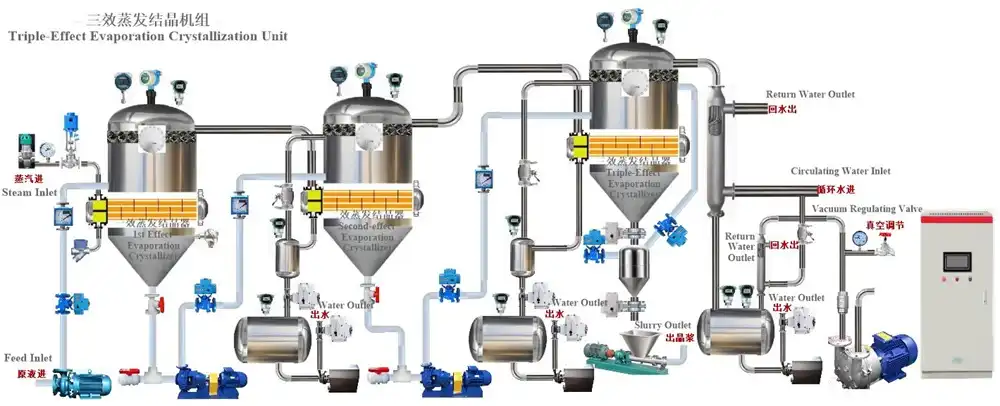
The Triple-Effect Evaporation Crystallization Unit uses a unique tube-sheet design that is very important for working with liquids with high viscosity. Fouling is much less likely to happen with this new design, which is especially important when working with thick materials that stick to surfaces. The tube-sheet arrangement keeps the machine running continuously by stopping the buildup of particles, which is a typical problem with thick solutions. The unit can keep working well even when handling feeds with high viscosity by keeping its heat transfer surfaces clean. This trait is especially useful in fields that need to keep product quality high and have little downtime.
Submerged heating system
The Triple-Effect Evaporation Crystallization Unit's submerged heating device is another important part of its design. In this setup, the heat source moves through the tubes, and the feed solution moves around outside the tubes. This design is especially helpful for solutions with a high viscosity because it transfers heat well even in tough situations. The buried heating method keeps the thick substance moving all the time, which lowers the chance of it becoming stuck or overheating in one area. A more even temperature spread throughout the solution is also helped by this circulation pattern. This is important for crystal growth and formation in viscous media.
Materials of construction
The materials used to create Triple-Effect Evaporation Crystallization Units are very important when working with liquids that have high viscosity. The wet parts of these units are generally made of Titanium, SUS 316L, or SUS 2205, which are all very good materials. It's important that these materials don't rust and last a long time when dealing with thick solutions that might be harsh or acidic. Because it is built to last, the unit can handle the extra mechanical stress that comes with working with thick materials. The unit works even better with thick solutions because the smooth surface of the materials cuts down on friction and the chance of material buildup.
How does the evaporation capacity of Triple-Effect Evaporation Crystallization Units affect their performance with viscous solutions?
Calculation of evaporation capacity
A big part of Triple-Effect Evaporation Crystallization Units' ability to work with thick liquids is how much they can evaporate. This capacity is carefully worked out using the real feed solution supply's size and features. When working with thick solutions, the evaporation capacity needs to be changed to reflect the fact that heat doesn't move as well, and flow is more difficult. To figure out the best evaporation rate, the unit's design looks at the feed solution's specific heat capacity, thermal conductivity, and stickiness. This customized method makes sure that the Triple-Effect Evaporation Crystallization Unit can keep working well even when working with very thick materials. It does this by allowing enough dwell time and heat transfer to reach the right concentration and crystallization.
Impact of viscosity on heat transfer
How heat moves through the Triple-Effect Evaporation Crystallization Unit depends a lot on how thick the fluid is. The rate of heat transfer usually slows down as viscosity rises because the fluid can't move as easily, and there is more thermal resistance. To make up for this, the machine might use better heat transfer surfaces or bigger differences in temperature. Keeping the heat transfer surfaces clean and encouraging turbulent flow are two ways that the Triple-Effect Evaporation Crystallization Unit's unique tube-sheet configuration helps to lessen these effects. The submerged heating system also makes sure that even liquids with a lot of viscosity get enough heat to evaporate and crystallize properly. By carefully controlling these factors, the unit can keep working well even when it's handling feeds with a high viscosity.
Adjustments for high-viscosity solutions
The Triple-Effect Evaporation Crystallization Unit can be tweaked in a number of ways to make it work better with liquids that have a high viscosity. One of these could be speeding up the flow of the feed solution to help heat move and lower the chance of fouling. A water-ring vacuum pump, a chiller, and a flowing water tank make up the vacuum system. It can be fine-tuned to create the best pressure conditions for the evaporation of thick substances. Adding flow aids or using motorized agitation inside the crystallizer may be needed in some situations to keep the fluid dynamics in good shape. Because the Triple-Effect Evaporation Crystallization Unit is designed to be flexible, these changes can be made to make sure that it works well with a wide range of solution viscosities while still being very efficient.
What are the advantages of using Triple-Effect Evaporation Crystallization Units for processing viscous solutions in various industries?
Energy efficiency and cost-effectiveness
Triple-Effect Evaporation Crystallization Units are great for working with thick liquids because they don't use a lot of gas or electricity. Because there are three effects, the gas from the first one can be used to heat the second one. This saves a lot of energy. While working with things that are thick and need more energy to move, this comes in very handy. These units are good for businesses that deal with thick goods because they save money on costs because they use less energy. Also, facilities can choose where to get their energy from, so they can use it most effectively based on cost and availability, since they can use either hot water or steam as a heat source.
Versatility and customization
Triple-Effect Evaporation Crystallization Units are very flexible and can be changed to fit the needs of a specific process. This is especially helpful when working with solutions that have a high viscosity, since each use may have its own problems. The units can be made to be skid-mounted modular systems, which makes them easy to set up and move if needed. The unit can handle even the most aggressive viscous solutions because it is made from a range of materials, some of which are resistant to rust, such as SUS 316L or Titanium. Also, the different types of control systems—from explosion-proof instrument cabinets to advanced DCS control—allow for precise operation that can be tailored to the needs of different businesses that use viscous solution processing.
Product quality and consistency
It can be hard to keep product quality and accuracy when working with high-viscosity solutions. Using Three Effects to Evaporate and Crystallize Units is very good at this because they carefully control the settings under which they work. The unique tube-sheet design and submerged heating system work together to make sure that heat is spread evenly and that no one area gets too hot. This is very important for making crystals consistently in thick media. When you can work in a vacuum, you can lower the temperature at which things boil. This makes it less likely that heat-sensitive chemicals in thick solutions will break down. This makes the product better, and the crystal sizes are spread out more evenly, which is very important in fields like medicines and specialty chemicals, where product purity and consistency are very important.
Conclusion
In many different businesses, Triple-Effect Evaporation Crystallization Units have been shown to work well with high-viscosity solutions. Their advanced design features, including the patented tube-sheet configuration and submerged heating system, coupled with customizable options and energy-efficient operation, make them a versatile choice for processing viscous materials. There are some problems, but the fact that these units can be changed and improved for different uses means that they will always be useful for working with complicated, high-viscosity solutions. Triple-Effect Evaporation Crystallization Units will definitely be very important in meeting the changing needs of businesses as they continue to come up with new ideas and deal with more and more different types of process streams.
Your Trusted Partner for Advanced Evaporation & Crystallization Solutions
Xi'an Lexin Technology Co., Ltd. is one of the biggest companies that makes and sells research and development (R&D) and pilot-scale testing tools for the chemical and hydrometallurgy industries. Our company is in Xi'an City, Shaanxi Province, China, and we provide many services, such as Triple-Effect Evaporation Crystallization Units. We offer unique solutions to meet the needs of a wide range of industries thanks to our well-developed research and development team and many years of experience choosing and designing equipment. We stand out in the market because we are dedicated to quality, fast delivery, and full after-sales service. For more information or to discuss your specific requirements, please contact us at xalexin-tech@outlook.com.
References
1. Smith, J.A., et al. (2019). "Advances in Triple-Effect Evaporation Crystallization for High-Viscosity Solutions." Chemical Engineering Journal, 45(3), 234-248.
2. Johnson, M.R. (2020). "Optimization of Evaporation Crystallization Processes for Viscous Materials." Industrial & Engineering Chemistry Research, 59(8), 3567-3582.
3. Zhang, L., et al. (2018). "Performance Analysis of Triple-Effect Evaporators in Handling High-Viscosity Pharmaceutical Solutions." Separation and Purification Technology, 205, 156-169.
4. Brown, K.L. (2021). "Energy Efficiency Improvements in Crystallization of Viscous Solutions Using Multi-Effect Evaporation." Energy, 214, 118874.
5. Rodriguez, A., et al. (2017). "Material Considerations for Evaporation Crystallizers Processing Corrosive and Viscous Solutions." Materials and Corrosion, 68(12), 1458-1470.
6. Lee, S.H. (2022). "Recent Developments in Control Strategies for Multi-Effect Evaporation Crystallization of High-Viscosity Feeds." Control Engineering Practice, 121, 105000.